Merger Markers
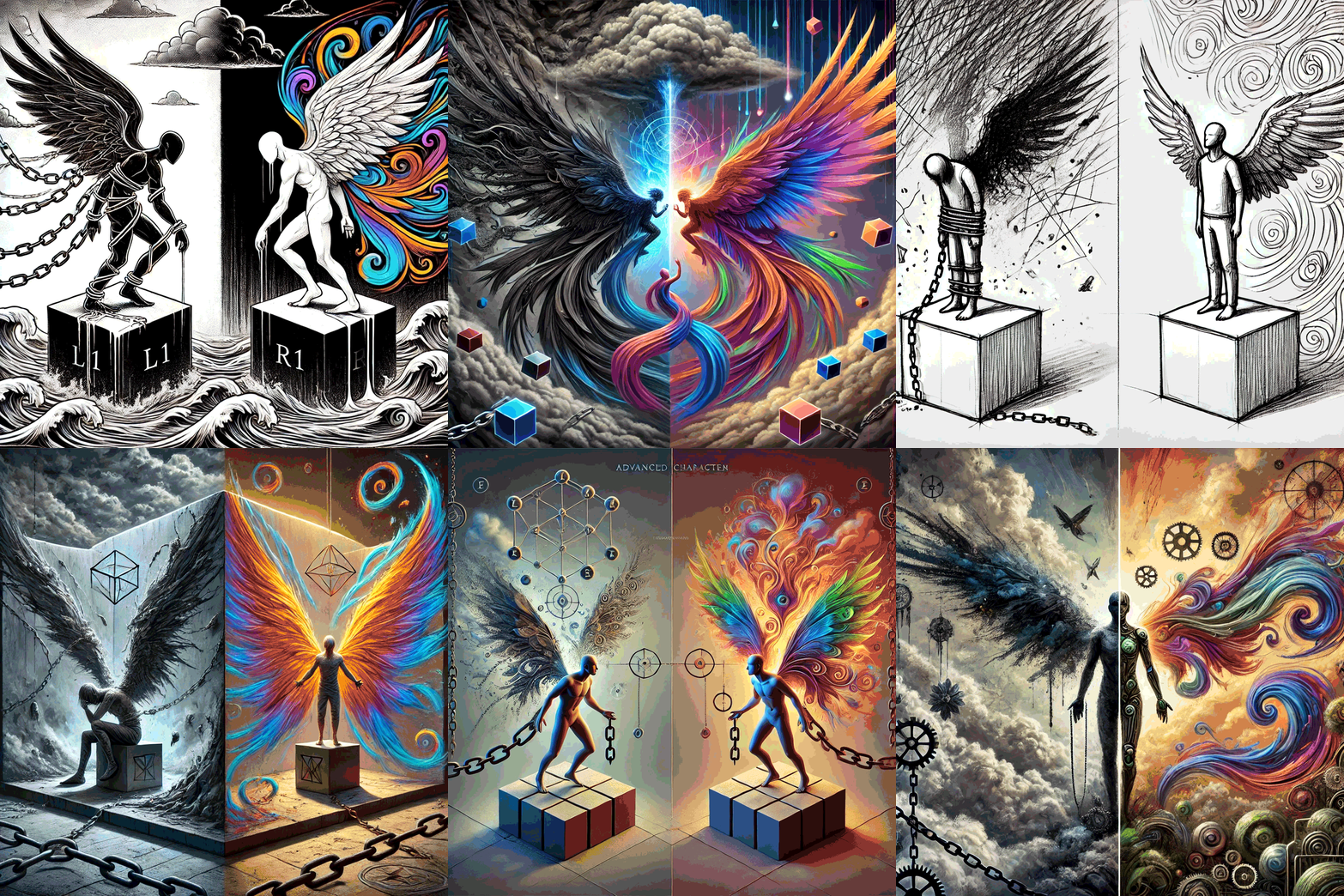
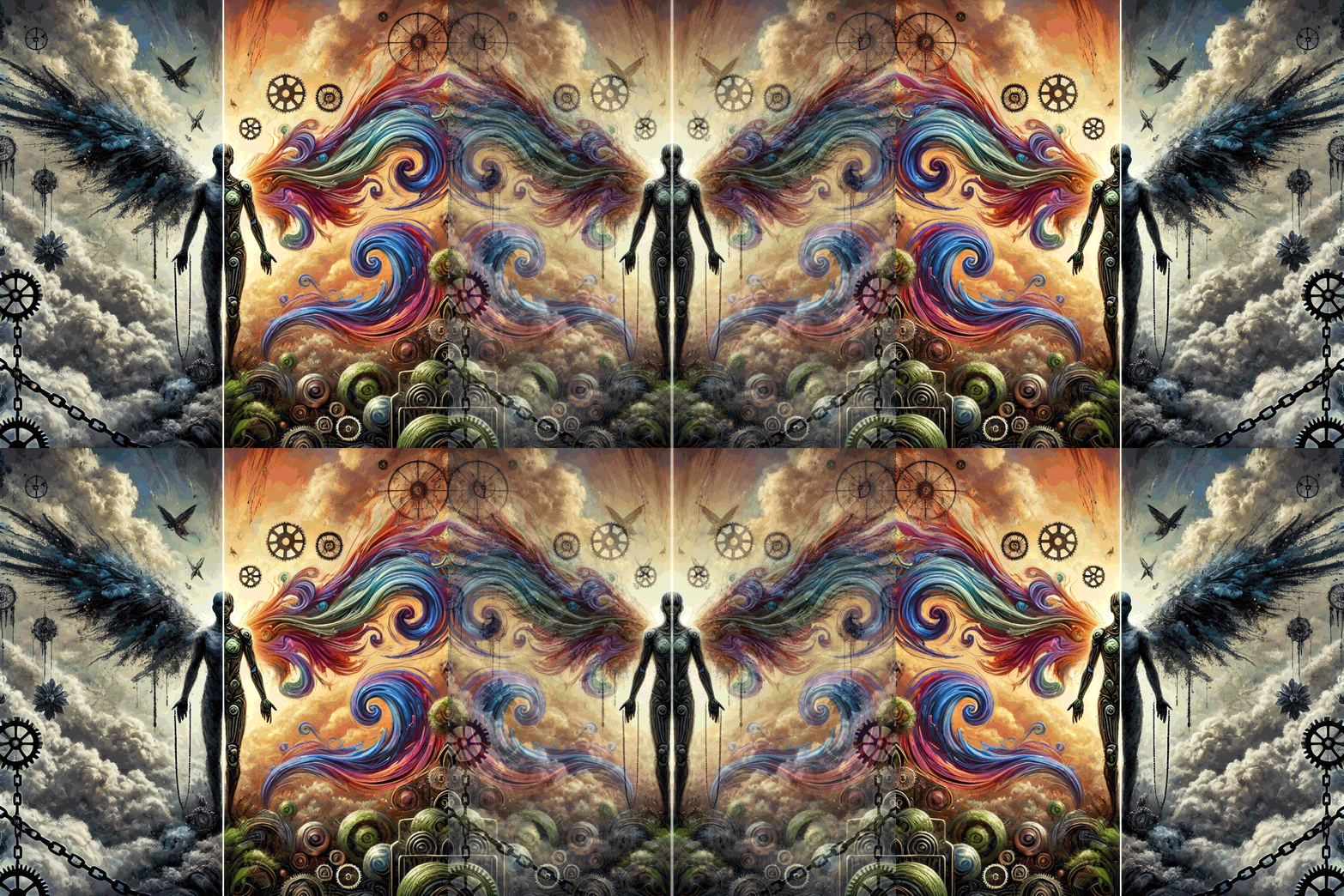
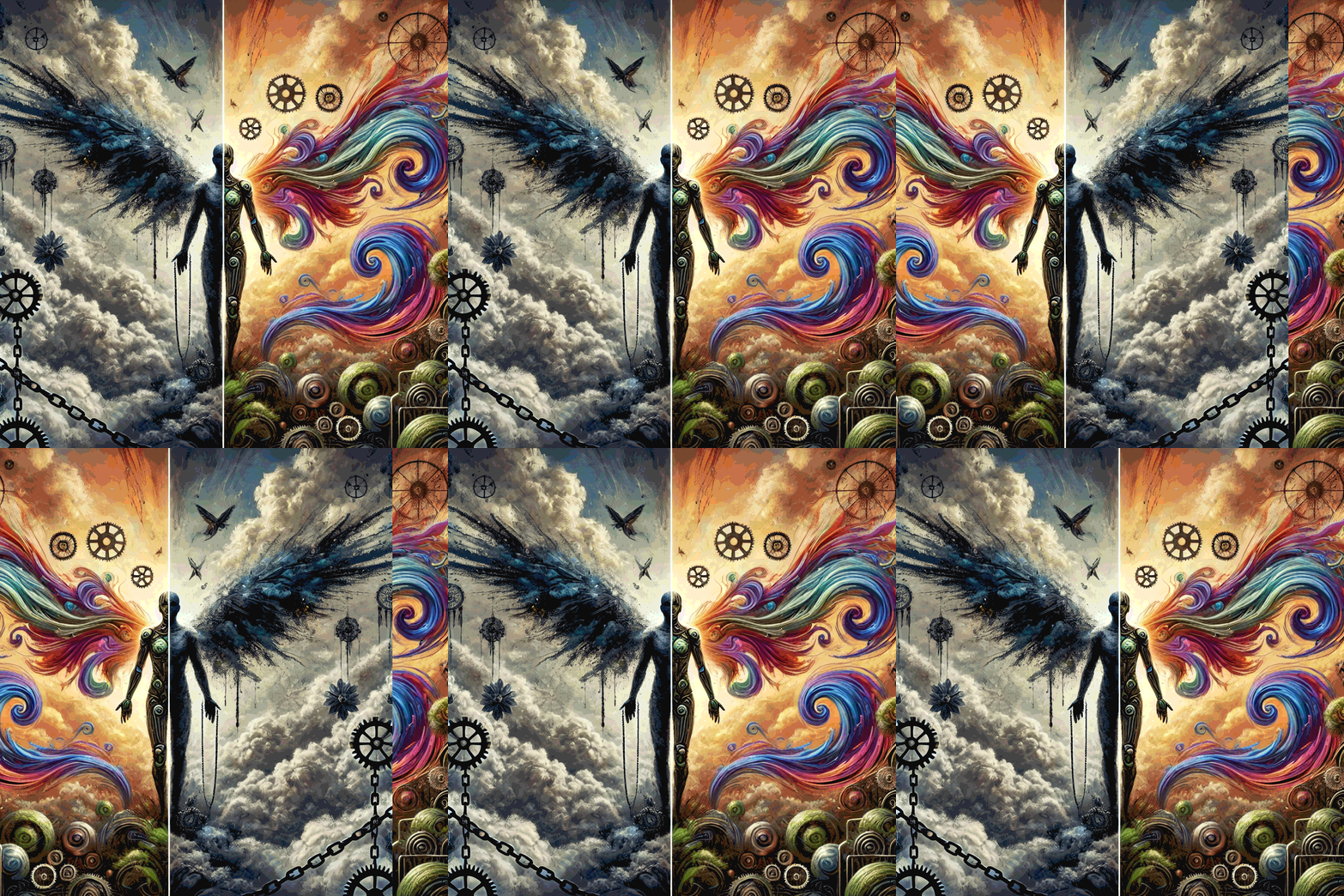
Merger Markers are visual cues designed to guide the eyes to specific points in two complementary images so that they can merge and reveal hidden or enhanced effects. The methodology behind Merger Markers is deeply rooted in how the brain processes binocular disparity, where each eye perceives a slightly different image. When combined with intentional markers placed within both the left and right images, these convergence points can control how and where the viewer focuses, allowing for the creation of complex visual effects such as depth perception, stereoscopic illusion, and even animated shifts.
How Merger Markers Work:
Purpose: The Merger Markers act as "stopping points" for the eyes, helping them to converge at precise points in the left and right images. As the eyes converge at these markers, the brain fuses the two images together into a single, coherent visual experience.
Placement: The markers are strategically placed at varying depths or positions within the images, creating layers or zones of focus. For example, a marker closer to the viewer may create the illusion that objects near the foreground become more focused, while distant markers simulate depth as the viewer shifts focus between them.
Depth and Motion: By adjusting the positions and characteristics of the markers in each image, you can create not only depth but also subtle motion effects. As the eyes move from one marker to the next, the brain interprets this as an animation or a shifting scene, much like flipping through sequential frames of an animation.
Guiding Eye Movement: The markers guide the viewer's eyes in a controlled pathway, much like following a visual trail or a pattern. This method allows the designer to encode a sense of motion, rotation, or transformation as the eyes follow from one marker to the next.
Multiple Layers: The images can contain multiple layers, each associated with a different set of merger markers. As the viewer's eyes adjust their focus between these markers, new layers or hidden objects can be revealed, enhancing the dynamic experience.
Applications of Merger Markers:
Depth Perception: When the markers are positioned at different horizontal or vertical depths in both images, the viewer experiences a multi-layered depth effect. This is especially useful in stereoscopic images where a slight shift in the positioning between the two images gives the illusion of 3D.
Subtle Animation: A small shift in the position or size of objects between two images, guided by the merger markers, can create the illusion of movement or animation. As the eyes move from one marker to another, they perceive a subtle transformation, making static images feel dynamic.
Optical Effects and Illusions: By placing multiple convergence markers closely together, designers can create moiré patterns, where small, repetitive shifts in the alignment of the images generate vibrant visual illusions. Similarly, the markers can be used to encode hidden images or reveal secondary patterns that only appear once the eyes focus at the correct depth.
Example of Merger Markers:
1L (Left Image): Contains a series of markers placed near a central object like a sphere. These markers guide the eyes to focus on specific points of the object as it shifts or rotates.
1R (Right Image): A corresponding set of markers that slightly differ in their placement, mimicking how the right eye would perceive the object from a slightly different angle.
1LM (Left Mirrored): A mirrored version of 1L can be used to create symmetry or rotational effects. When the left and right images are combined with this mirrored version, the resulting effect is a perception of the object rotating or flipping in space.
1LW (Left Flipped): In this case, flipping the left-side image horizontally creates an even more dramatic effect when combined with the right image. The eyes interpret this as a shifting scene or a dynamic transformation as they move between markers.
By carefully placing Merger Markers in each image, a wide variety of special effects can be achieved. The human brain, interpreting these subtle differences, enables a fusion of images that gives rise to motion, depth, and illusionary effects, transforming static images into immersive, interactive experiences.
Viewing Instructions:
Start by focusing on Marker 1 (top left). Cross your eyes until the images overlap. The cube will begin to rotate slightly.
Move to Marker 2 (top right). Cross your eyes again, and the cube will shift further, enhancing the sense of rotation.
Finally, focus on Marker 3 (bottom center). As you merge the images, the cube will appear to tilt and change perspective, adding depth.
This sequential focus creates both a stereographic depth effect and the illusion of rotation. Let me know if you'd like further adjustments or improvements
Convergence Markers: An Overview
Convergence Markers are specific points or areas within an image that are designed to align when two images are viewed stereoscopically or superimposed. These markers guide the viewer’s eyes to certain locations, helping the two images fuse into one cohesive third image. When properly used, convergence markers enhance the depth, visual coherence, and even create hidden effects or images. They function much like points in an autostereogram, where the eyes must "cross" at specific spots to reveal depth or hidden images.
Purpose of Convergence Markers:
Alignment: Help merge two separate images into a single coherent image when viewed stereoscopically.
Visual Depth: By aligning key points (such as character features, objects, or symbols), convergence markers create a sense of depth or movement.
Hidden Layers: Convergence markers can also be used to reveal hidden images or additional layers of meaning that are not visible unless the images are viewed in a specific way.
Emphasizing the Narrative: Key narrative elements (such as emotional shifts or the transition from chaos to creativity) can be accentuated through convergence markers.
Proposed Image Series to Illustrate Convergence Markers:
Image 1: Simple Convergence Markers on Basic Elements
Description: Two characters standing side by side, facing forward. Simple convergence markers will be placed on basic elements, such as the heads, hands, and feet of the characters. These markers will exaggerate how the figures align when the images are merged.
Objective: Demonstrate the foundational concept of convergence markers with exaggerated points to make them easily understood.
Image 2: Advanced Convergence Markers with Symbolic Alignment
Description: Two characters facing forward, each surrounded by symbolic elements. Convergence markers will be placed on more complex elements, such as wings, flowing chains, and parts of the imagination cloud. When merged, hidden visual effects (e.g., the chains forming wings) will appear at these convergence points.
Objective: Show how convergence markers can be used to align more complex elements and create hidden images.
Image 3: Narrative-Driven Convergence Markers
Description: Two characters, one representing fear and the other hope, with environmental convergence markers aligning not just on the characters but also on elements in the background (clouds, abstract shapes). When merged, these markers will form a new, unified scene that symbolizes balance and transformation.
Objective: Illustrate how convergence markers can drive a narrative and convey deeper symbolic meaning through stereoscopic fusion.
Image 1: Simple Convergence Markers on Basic Elements

In this first image, I've placed exaggerated convergence markers on the heads, hands, and feet of both characters. These markers guide the viewer’s eyes to key alignment points, helping achieve stereoscopic fusion. The left character, representing darkness and isolation, is depicted with muted tones, while the right character, representing hope and creativity, features brighter tones.
Image 1: Simple Convergence Markers on Basic Elements
In this first image, convergence markers are placed on the key elements of two characters:
Head: The heads of both characters will align perfectly when viewed stereoscopically, serving as a focal point for visual fusion.
Hands: The hands will align to create a sense of unity between the characters' actions.
Feet: Placing convergence markers on the feet ensures the characters stand on the same ground, enhancing spatial coherence.
These markers are exaggerated to make their positions clear and will guide the viewer’s eyes to these points for alignment.
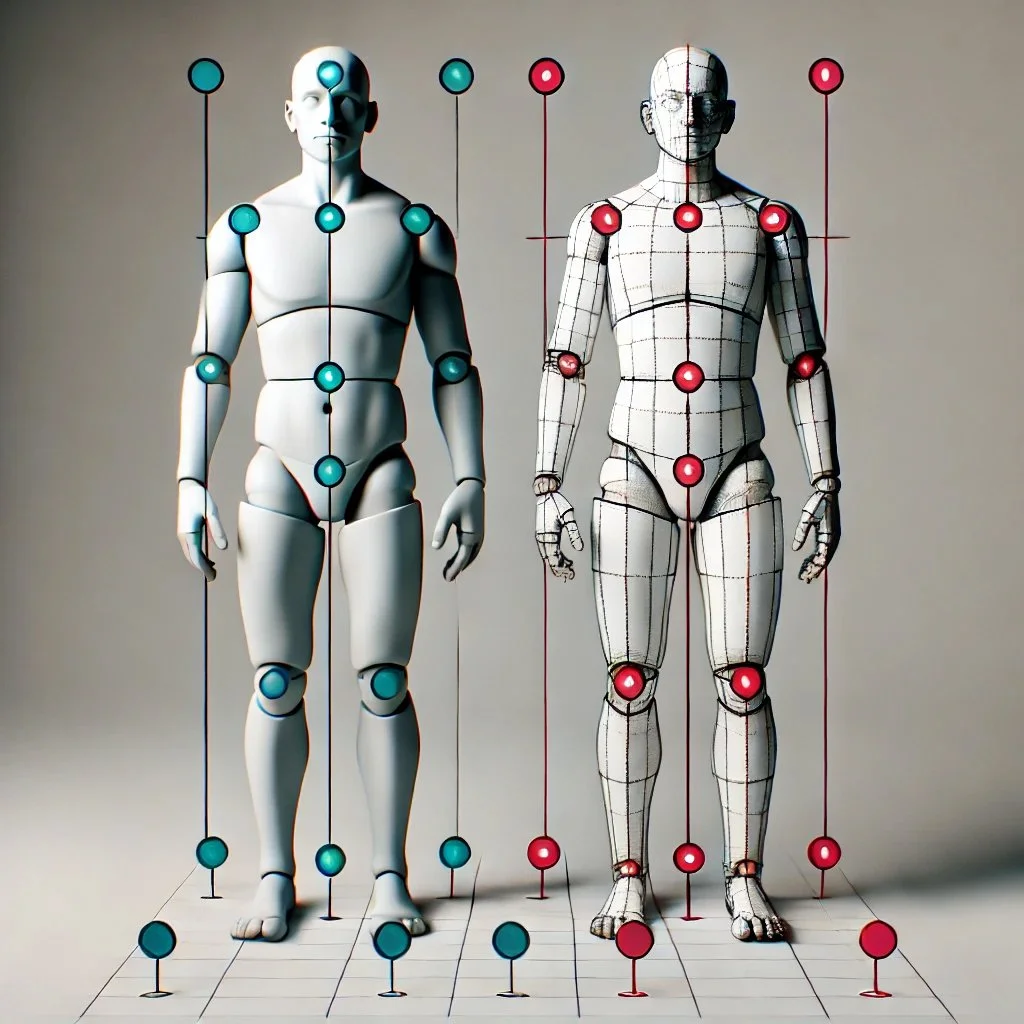
This image demonstrates the foundational concept of convergence markers placed on basic elements of two characters. The markers are exaggerated on their heads, hands, and feet to clearly highlight how alignment happens when the images are merged or viewed stereoscopically.
Would you like to pr
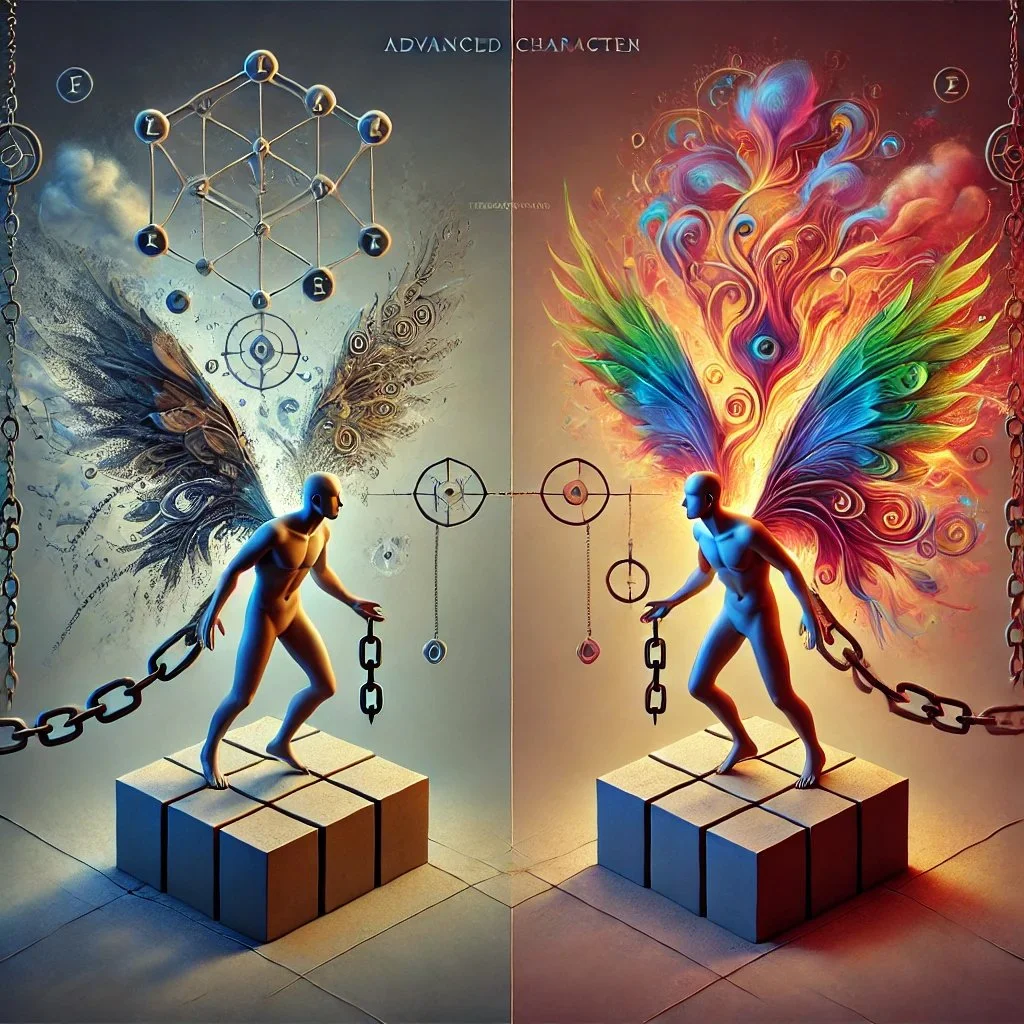
Image 2: Advanced Convergence Markers with Symbolic Alignment
The image above demonstrates the use of advanced convergence markers, showing two characters with symbolic elements: one representing fear and isolation, the other representing hope and creativity. The convergence markers are placed on the wings, chains, and imagination cloud to create hidden visual effects when aligned.

Here is the second image with advanced convergence markers placed on the wings, flowing chains, and parts of the imagination cloud. These markers are designed to reveal hidden visual effects, such as chains forming wings, when the image elements align during stereoscopic merging. This step demonstrates the use of more complex elements and how their symbolic alignment can create additional imagery.
Image 3: Narrative-Driven Convergence Markers

In this image, the two characters, representing fear and hope, are accompanied by environmental convergence markers placed not only on their wings and chains but also within the surrounding abstract shapes, like the clouds and flowing lines in the background. These markers, when aligned, will create a unified narrative of transformation, with jagged shapes and stormy clouds on the left converging into the more hopeful, creative elements of the right side. The symbolic markers are placed to emphasize balance and fusion through stereoscopic merging.
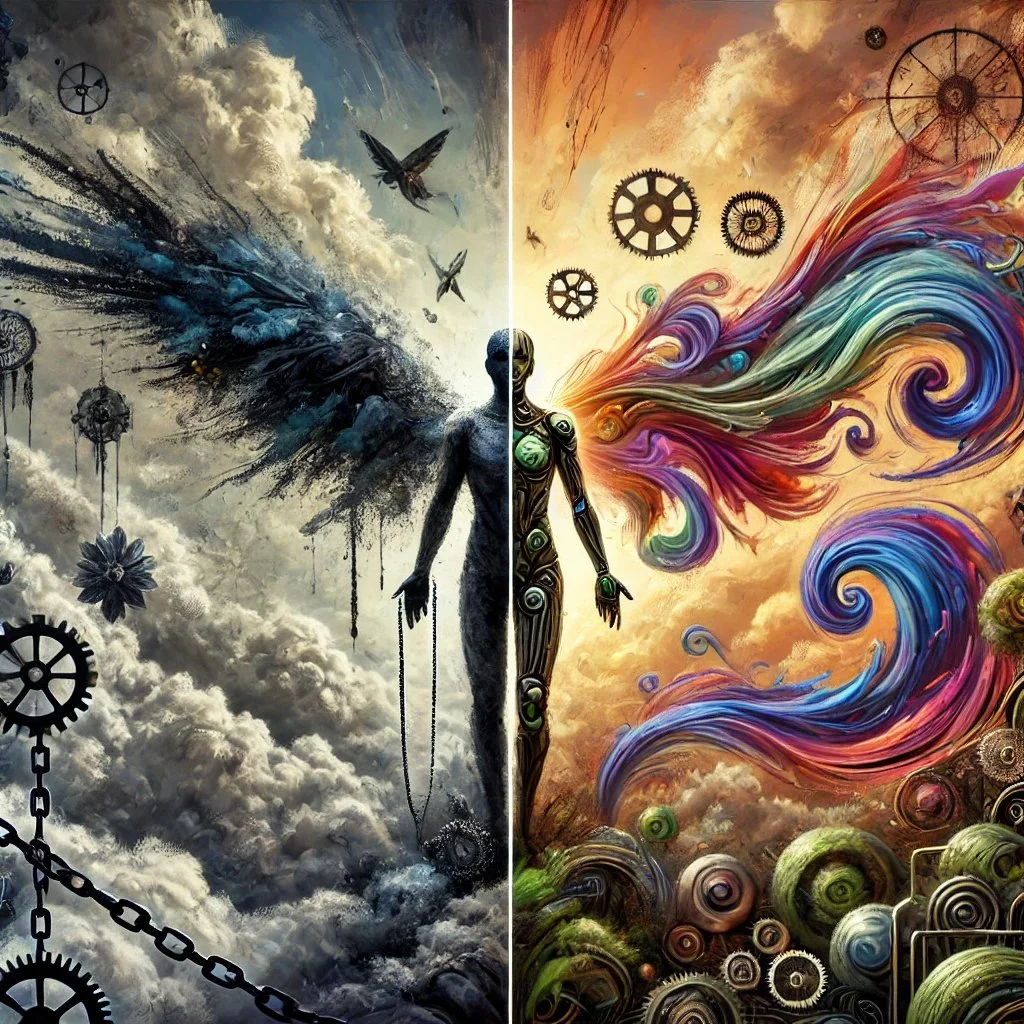
The image above demonstrates the use of narrative-driven convergence markers, where each side represents a distinct concept (fear and hope), and the environment enhances the stereoscopic fusion effect. Each side merges into a unified scene when combined, creating a new visual narrative that symbolizes balance and transformation.