Color
Crafting a self-guided prompt
Now I’m focusing on creating a self-guided prompt to craft the content on color, mirroring the earlier structured overviews of vision, computer vision, cameras, and light.
Mapping a detailed explanation
I’m piecing together a comprehensive explanation on "color," echoing past requests for a detailed analysis. This exploration will mirror previous structure and depth, ensuring consistency and thoroughness.
Examining computer vision
I’m mapping out the evolution and functioning of computer vision, detailing groundbreaking milestones, the technology's operation, and future developments.
Wondering about cameras
Now I'm thinking through how cameras capture and encode images, tracing light through lenses and sensors, recording it digitally, and how it is processed and displayed using CPUs or GPUs.
Tracing light's journey
I'm mapping out light's history and its discoveries, like photons and the double slit experiment. Exploring its progression, I’m curious about its frequency and color shifts.
Emphasizing thoroughness
Preparing a comprehensive analysis of "color," similar to past topics, by addressing definitions, history, components, mechanisms, associated phenomena, and future trends.
Crafting the self-prompt
The assistant generates a self-prompt to explore the topic of "color" without explicitly mentioning the self-prompt, adhering to OpenAI's guidelines.
Breaking down the concept
Starting with a clear approach to explain the concept of color, similar to previous explorations. Progressing methodically, I work through concepts and applications for a thorough understanding.
Breaking down color
I'm starting by defining color in physics and vision, then tracing its history and understanding over time, noting key experiments, and exploring its relation to light, vision, and technology.
Title: Color: The Spectrum of Perception and Reality
1. Defining Color: Physics and Perception
Scientific Definition: Explain how color is a result of light interacting with objects and how different wavelengths correspond to different colors in the visible spectrum (red to violet).
Perception in Humans: Explore how the human eye detects color via cones in the retina (red, green, and blue cones) and how the brain processes these signals to create the perception of color.
Dual Nature: Introduce the idea that color is both a physical reality (wavelengths of light) and a perceptual experience shaped by human biology.
2. The History and Evolution of Color Understanding
Ancient Theories: Discuss early beliefs about color, such as Aristotle’s ideas on the blending of light and darkness to create color.
Isaac Newton’s Prism Experiment: Describe how Newton demonstrated that white light is composed of various colors using a prism.
Color Theory: Introduce the development of color theory, such as the color wheel, and the work of scientists like Goethe.
Modern Advances: Touch on how modern technology, like spectroscopy, has further refined our understanding of light and color.
3. Components and Mechanisms of Color Vision
The Eye and Photoreceptors: Describe how the eye detects color using cones, distinguishing between three types (red, green, and blue). Explain the role of rods for light intensity but not color.
Color Processing in the Brain: Detail how the visual cortex processes color information and how it distinguishes between different hues.
Color Blindness: Discuss common color vision deficiencies and how they affect perception.
4. Color Phenomena
Color Temperature: Explain how color temperature (warm vs. cool tones) affects perception and mood.
Metamerism: Discuss how different combinations of wavelengths can produce the same perceived color.
Color Constancy: Explore how the brain maintains consistent color perception under varying lighting conditions.
Simultaneous Contrast: Describe how the perception of a color is influenced by surrounding colors.
5. The Role of Color in Technology
Color Displays: Explain how digital screens use RGB (red, green, blue) to create a wide range of colors.
Color in Printing: Introduce the CMYK color model used in printing and how it differs from the RGB model.
Color in Imaging: Describe how cameras and imaging technologies capture and reproduce color, mirroring the processes in human vision.
6. Future Trends in Color Technology
Advanced Display Technologies: Discuss emerging technologies like quantum dot displays that enhance color accuracy.
Augmented Reality: Explore how color is being integrated into augmented reality and how it influences human-computer interaction.
Color in AI and Computer Vision: Look into how machines are being trained to recognize and interpret color in real-world applications, from object detection to mood analysis.
7. Conclusion: The Interplay of Color in Reality
Recap how color is a bridge between the physical world and human perception.
Highlight how our understanding of color continues to evolve with new discoveries in science, technology, and art.
This breakdown mirrors the structure and depth of previous explorations, allowing for a thorough and cohesive analysis of "color."
Color: The Spectrum of Perception and Reality
From the vibrant hues of a sunset painting the sky to the subtle shades that convey emotion in art, color is an intrinsic part of our experience of the world. It influences our moods, decisions, and even physiological responses. Yet, color is both a physical phenomenon and a perceptual experience—a bridge between the external world and our internal interpretation of it. This section delves into the multifaceted nature of color, tracing its scientific understanding, historical evolution, and the profound ways it shapes our perception of reality.
Introduction
Color is more than just a characteristic of visual perception; it's a complex interplay between light, matter, and the observer. It arises from the way objects interact with light and how our visual system interprets these interactions. Understanding color involves exploring physics, biology, psychology, and technology. This comprehensive exploration will dissect the concept of color, its historical context, scientific principles, and applications in various fields.
Table of Contents
What Is Color?
Physical Definition
Perceptual Experience
Historical Evolution of Color Theory
Ancient Philosophies of Color
Newton's Prism Experiments
Development of Color Theory
Modern Understanding
The Physics of Color
Electromagnetic Spectrum and Visible Light
Wavelengths and Color Perception
Absorption, Reflection, and Transmission
Dispersion and the Formation of Rainbows
Color Perception in Human Vision
Anatomy of the Eye: Rods and Cones
Trichromatic Theory
Opponent Process Theory
Color Constancy
Color Blindness and Deficiencies
Color Models and Spaces
Additive Color (RGB)
Subtractive Color (CMYK)
CIE Color Spaces
HSV, HSL, and Other Models
Phenomena Related to Color
Color Temperature
Metamerism
Afterimages and Optical Illusions
Color and Emotion
Technological Applications of Color
Color in Digital Imaging
Color Calibration and Management
Printing Technologies
Color in Displays and Screens
Color in Art and Culture
Symbolism and Meaning
Use in Visual Arts and Design
Cultural Variations in Color Interpretation
Advanced Concepts and Future Directions
Quantum Dots and Color Control
Color in Virtual and Augmented Reality
Advances in Display Technology
Color Psychology in Marketing and User Experience
Proposed Subtopics and Further Exploration
1. What Is Color?
Physical Definition
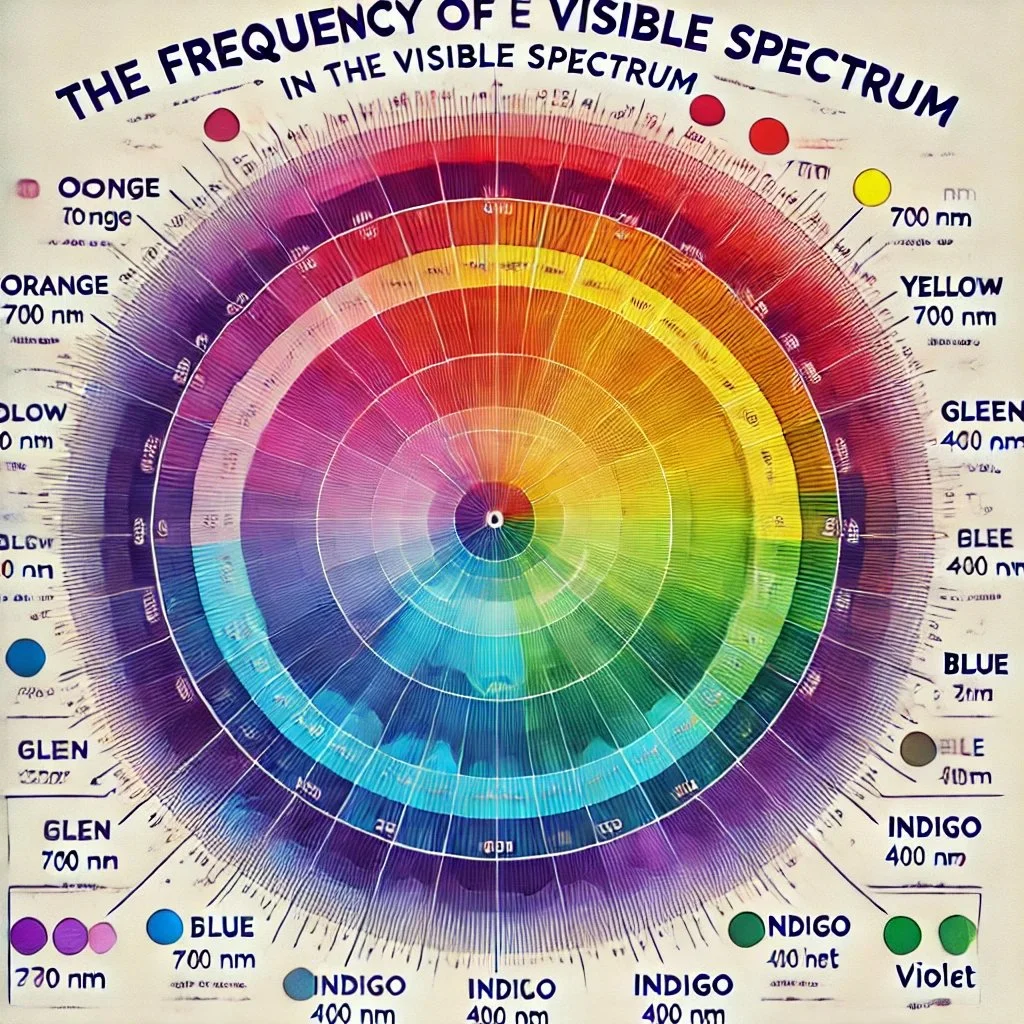
Color is a property of light as seen by people. Physically, it is associated with electromagnetic radiation of a certain range of wavelengths visible to the human eye, approximately from 380 nm to 750 nm.
Wavelength and Frequency: Different colors correspond to light waves of different wavelengths and frequencies.
Perceptual Experience
Color is also a perceptual phenomenon arising from the way our visual system interprets light signals.
Perception: Depends on the interaction between light, the object, and the observer's sensory system.
Subjectivity: Individual differences can affect color perception.
2. Historical Evolution of Color Theory
Ancient Philosophies of Color
Aristotle: Believed color was a mix of light and dark.
Plato: Proposed that color is a product of the interaction between the eye and light.
Newton's Prism Experiments
Isaac Newton (1666):
Demonstrated that white light is composed of a spectrum of colors.
Used a prism to split sunlight into its constituent colors.
Introduced the color circle.
Development of Color Theory
Johann Wolfgang von Goethe:
Emphasized human perception of color.
Explored psychological effects.
Thomas Young and Hermann von Helmholtz:
Proposed the trichromatic theory of color vision.
Suggested that the eye has three types of receptors.
Modern Understanding
Quantum Mechanics:
Explains atomic and molecular interactions with light.
Provides insights into color emission and absorption.
Colorimetry:
The science of measuring and describing color.
3. The Physics of Color
Electromagnetic Spectrum and Visible Light
Electromagnetic Spectrum: Encompasses all types of electromagnetic radiation.
Visible Spectrum: The portion detectable by the human eye.
Wavelengths and Color Perception
Short Wavelengths: (~380-450 nm) perceived as violet and blue.
Medium Wavelengths: (~450-600 nm) perceived as green to yellow.
Long Wavelengths: (~600-750 nm) perceived as orange to red.
Absorption, Reflection, and Transmission
Absorption: Objects absorb certain wavelengths and reflect others.
Reflection: The reflected wavelengths determine the color we perceive.
Transmission: Transparent materials allow light to pass through, affecting color.
Dispersion and the Formation of Rainbows
Dispersion: The separation of light into colors arranged by wavelength.
Rainbows: Caused by dispersion and internal reflection in water droplets.
4. Color Perception in Human Vision
Anatomy of the Eye: Rods and Cones
Rods:
Sensitive to light intensity (brightness).
Do not detect color.
Cones:
Responsible for color vision.
Three types: S-cones (short wavelengths), M-cones (medium), L-cones (long).
Trichromatic Theory
Principle: Color perception arises from the combination of signals from the three types of cones.
Opponent Process Theory
Concept: Visual system interprets color in antagonistic pairs (red-green, blue-yellow, black-white).
Explanation: Accounts for afterimages and certain color blindness.
Color Constancy
Definition: The ability to perceive colors of objects consistently under varying lighting conditions.
Color Blindness and Deficiencies
Types:
Protanopia: Lack of L-cones (red deficiency).
Deuteranopia: Lack of M-cones (green deficiency).
Tritanopia: Lack of S-cones (blue deficiency).
Impact: Affects color discrimination and perception.
5. Color Models and Spaces
Additive Color (RGB)
Principle: Colors created by mixing light of red, green, and blue.
Applications: Used in digital displays and lighting.
Subtractive Color (CMYK)
Principle: Colors created by subtracting light using pigments or dyes (cyan, magenta, yellow, black).
Applications: Used in printing.
CIE Color Spaces
CIE 1931 XYZ:
A mathematical model to describe color perception.
CIE L*a*b*:
Represents color in terms of lightness (L*) and color-opponent dimensions (a*, b*).
HSV, HSL, and Other Models
HSV (Hue, Saturation, Value):
Represents colors in terms of their shade, vibrancy, and brightness.
HSL (Hue, Saturation, Lightness):
Similar to HSV but with different representation of brightness.
6. Phenomena Related to Color
Color Temperature
Definition: Describes the hue of a light source in terms of the temperature of an ideal black-body radiator that emits light of comparable hue.
Measured in Kelvin (K):
Lower temperatures: Warm colors (reddish).
Higher temperatures: Cool colors (bluish).
Metamerism
Phenomenon: Different spectral compositions producing the same color perception.
Implications: Challenges in color matching across different devices or materials.
Afterimages and Optical Illusions
Afterimages: Visual images that persist after the stimulus is removed.
Explanation: Due to the adaptation of photoreceptors and opponent processes.
Color and Emotion
Psychological Effects:
Colors can influence mood and behavior.
Cultural associations affect interpretations.
7. Technological Applications of Color
Color in Digital Imaging
Sensors and Pixels:
Use of color filter arrays (e.g., Bayer filter) to capture color information.
Demosaicing: Reconstructing full-color images from incomplete color samples.
Color Calibration and Management
Purpose: Ensure consistent color reproduction across devices.
Tools: Color profiles (ICC profiles), calibration hardware and software.
Printing Technologies
Processes:
Offset Printing: Uses CMYK inks.
Digital Printing: Can include additional colors for expanded gamut.
Challenges: Achieving accurate color reproduction on different media.
Color in Displays and Screens
Technologies:
LCD: Uses backlighting and color filters.
OLED: Emits light directly from organic compounds.
Color Gamut: Range of colors a device can display.
8. Color in Art and Culture
Symbolism and Meaning
Red: Passion, danger, energy.
Blue: Calmness, stability.
Green: Nature, growth.
Use in Visual Arts and Design
Color Theory: Principles guiding the use of color in art.
Color Harmony: Pleasing arrangements of colors.
Cultural Variations in Color Interpretation
Variations: Colors can have different meanings in different cultures.
Example: White symbolizes purity in Western cultures but mourning in some Eastern cultures.
9. Advanced Concepts and Future Directions
Quantum Dots and Color Control
Quantum Dots: Nanoparticles that emit light at specific wavelengths when excited.
Applications: High-definition displays with wider color gamuts.
Color in Virtual and Augmented Reality
Challenges: Accurate color rendering in immersive environments.
Advancements: Improved displays and rendering algorithms.
Advances in Display Technology
MicroLEDs: Offer high brightness and efficiency.
HDR (High Dynamic Range): Enhances contrast and color range.
Color Psychology in Marketing and User Experience
Influence: Color choices can affect consumer behavior.
Design: Strategic use of color in branding and interfaces.
10. Proposed Subtopics and Further Exploration
To expand the understanding of color, the following subtopics can be explored:
Color Vision Deficiencies
Genetic Causes
Adaptive Technologies
Color in Nature
Biological Pigmentation
Structural Coloration (e.g., butterfly wings)
Spectroscopy and Color Analysis
Absorption Spectra
Applications in Chemistry and Astronomy
Color in Language and Perception
Linguistic Relativity
Cross-cultural Studies
Advanced Color Technologies
HyperSpectral Imaging
Multispectral Cameras
Color Theory in Depth
Historical Development
Contemporary Theories
Color and Accessibility
Design for Color-Blind Users
Legibility and Contrast Standards
Environmental Impact on Color Perception
Lighting Conditions
Atmospheric Effects
Philosophical Perspectives on Color
Color Realism vs. Color Anti-Realism
Phenomenology of Color
Color in Psychological and Cognitive Sciences
Neurological Processing
Emotional and Cognitive Effects
Conclusion
Color is a multifaceted phenomenon that intertwines physics, biology, psychology, and art. It enriches our experience of the world, influences our emotions, and plays a crucial role in technology and communication. From the fundamental understanding of light and matter interactions to the complexities of human perception, color continues to be a subject of fascination and study. Advances in technology and science promise to deepen our understanding and expand the possibilities of how we utilize and perceive color in the future.
Further Reading and References
Books:
"Interaction of Color" by Josef Albers
"Color Science: Concepts and Methods, Quantitative Data and Formulae" by Günther Wyszecki and W.S. Stiles
"An Introduction to the Visual System" by Martin J.T.
Articles and Papers:
Research on color perception mechanisms
Studies on color usage in design and marketing
Online Resources:
Color theory tutorials on educational platforms
International Commission on Illumination (CIE) publications
This exploration of color underscores its significance in various domains. By examining color from multiple perspectives, we gain a comprehensive understanding of its role in shaping our perception, influencing technology, and enriching culture. As we continue to innovate and discover, color remains a vibrant and essential aspect of human experience.